
Press Conference
JAMA Press Conference September 2026
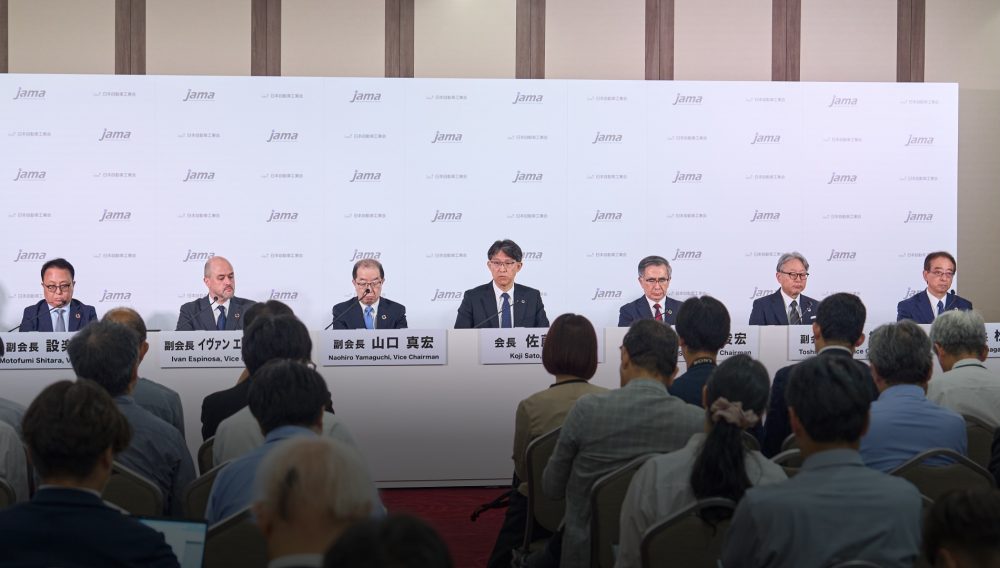
The Japan Automobile Manufacturers Association (JAMA) held a press conference on September 17, 2026.
The conference was conducted in two parts. In the first session, chairpersons from relevant JAMA committees discussed initiatives related to automated driving, one of the New Seven Priority Challenges facing the industry.
In the second session, seven senior officers, including JAMA’s Chairman and its six Vice Chairmen, took the stage. Chairman Koji Sato provided some updates on JAMA’s efforts to address the New Seven Priority Challenges. JAMA looks forward to the steady advancement of these initiatives, which will strengthen the international competitiveness of Japan’s automotive industry.
Chairman Sato also provided information on Japan Mobility Show Bizweek 2026 and an event marking the 50th anniversary of JAMA’s Washington, D.C. Office.
Full Archive of Press Conference
Creating Transportation Systems Integrating Automated Driving (New Priority Challenge #5)‒Achieving Zero Road Fatalities and Freedom of Mobility
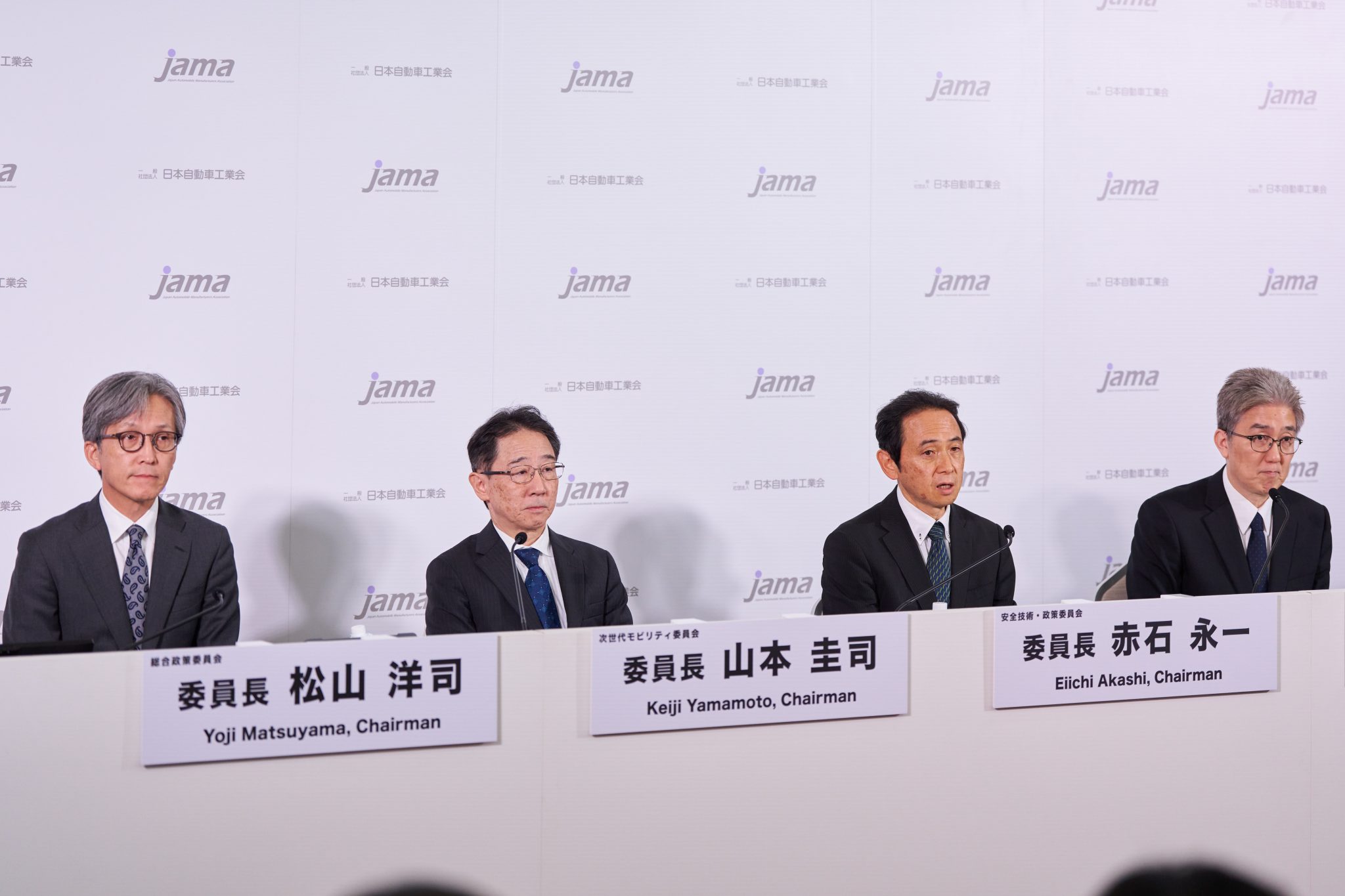
From left: Yoji MATSUYAMA, Chair, General Policy Committee (Toyota Motor); Keiji YAMAMOTO, Chair, Next-Generation Mobility Committee (Toyota Motor); Eiichi AKASHI, Chair, Safety Technology & Policy Committee (Nissan Motor); Akihiro SARADA, Vice Chair, Safety Technology & Policy Committee (Toyota Motor)
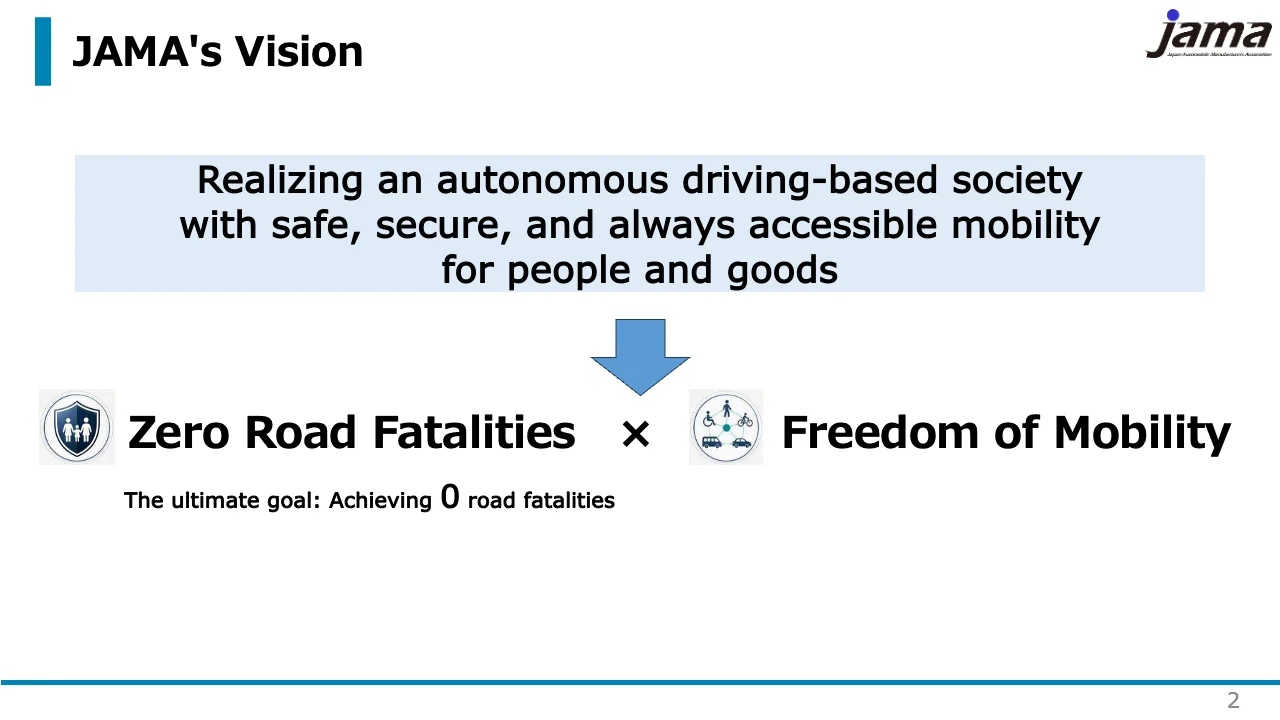
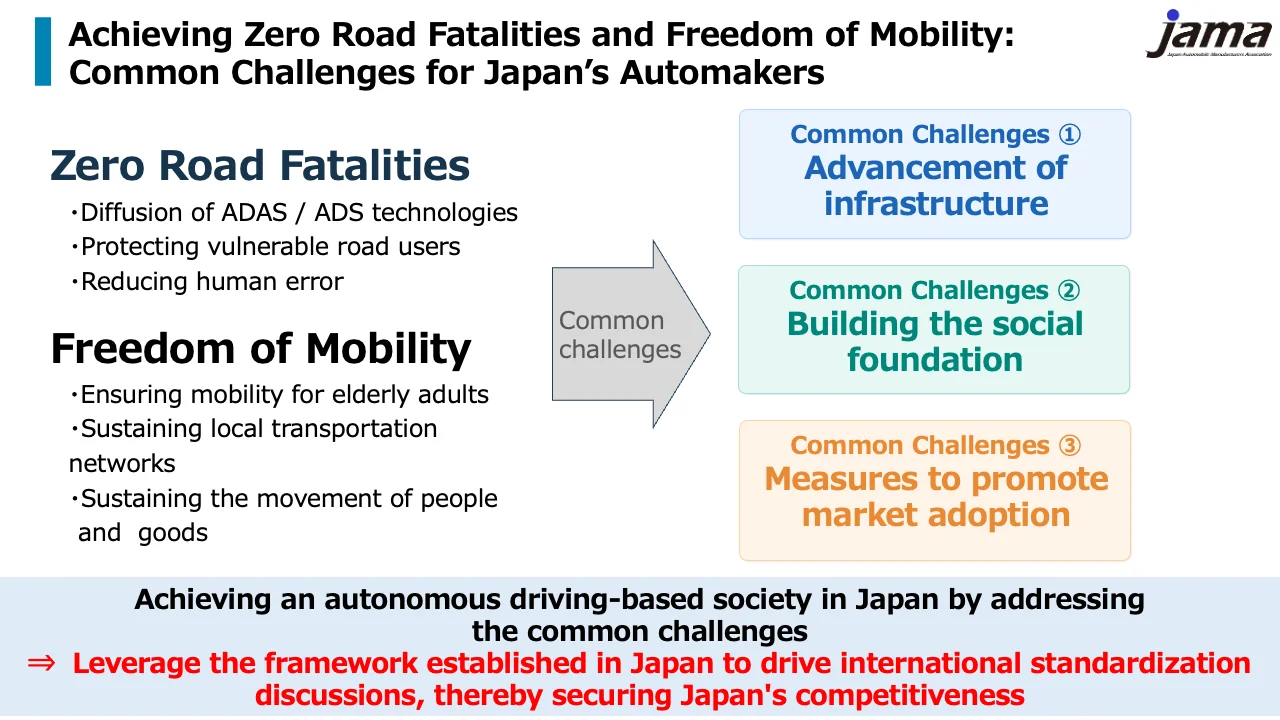
- JAMA’s vision is to realize an automated driving-based society in which people and goods can move safely, securely, and freely. The industry has established two objectives as its highest priorities in this regard: “Zero road fatalities” and “Freedom of mobility.” JAMA aims to promote efforts not only within the automotive industry but also across society, including national and local governments and related industries.
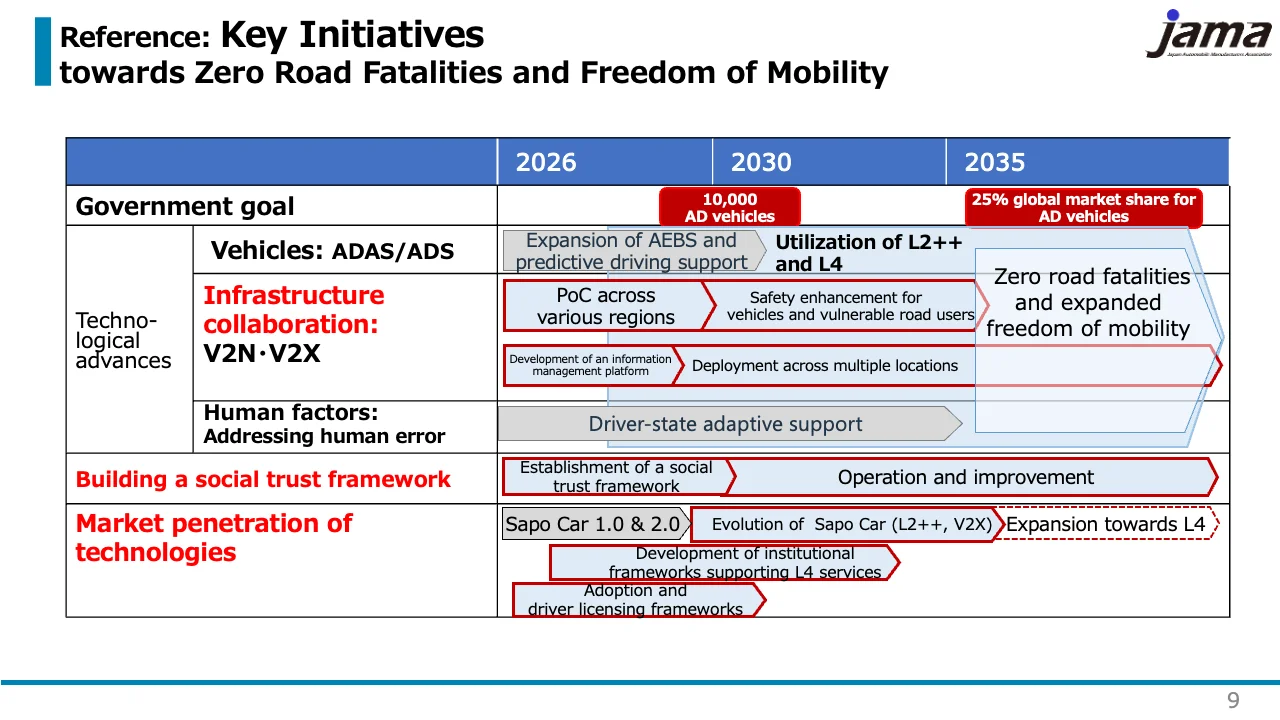
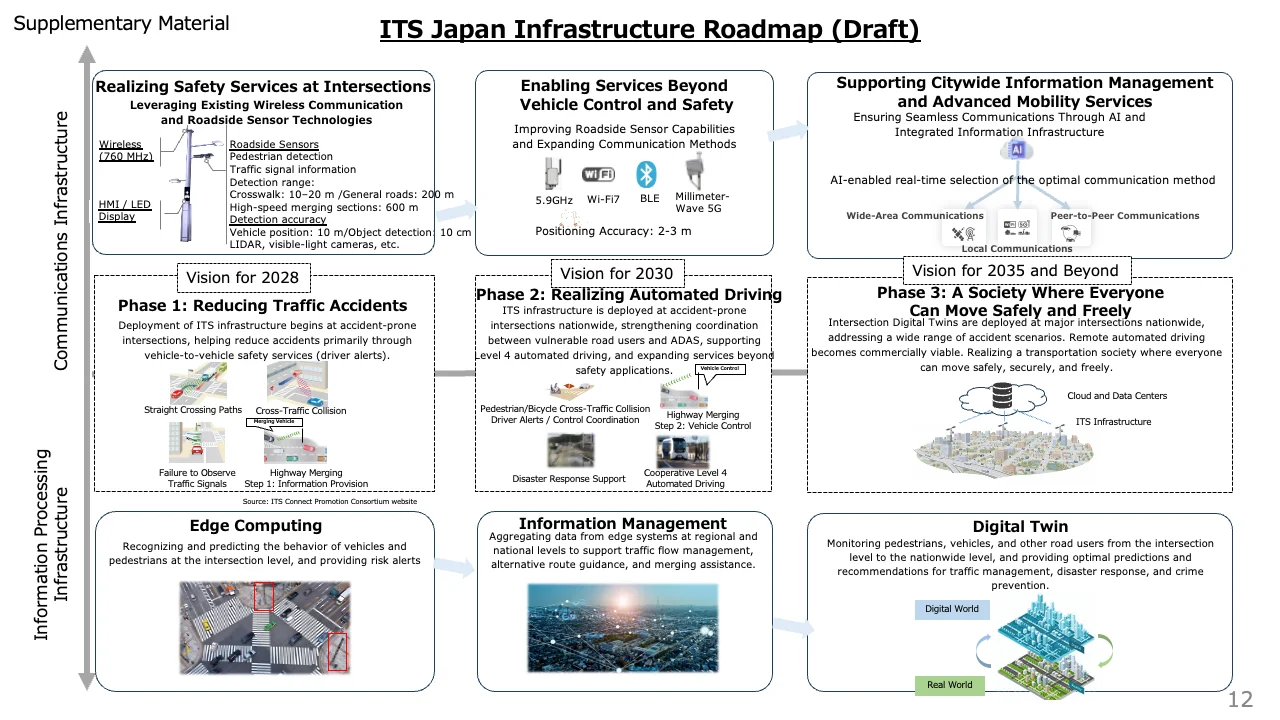
- In developing a roadmap towards those goals, JAMA identified three challenges common to both objectives: advancement of infrastructure technologies, development of social foundations, and market adoption measures. By advancing these common challenges and connecting the resulting frameworks to international standardization, JAMA aims to help secure Japan’s competitiveness in this area of development.
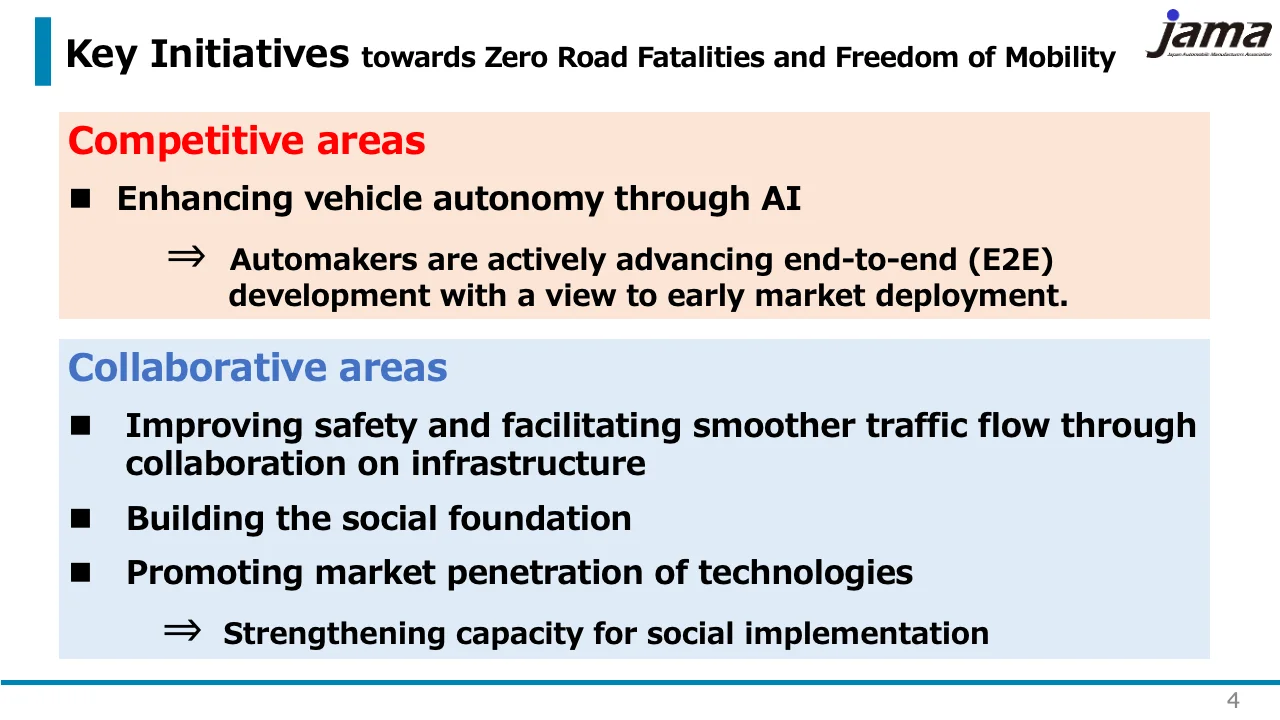
- While improvements in autonomous driving performance through the use of artificial intelligence and end-to-end technologies remain areas of competition among individual companies, infrastructure coordination, social trust foundations, and market adoption are areas for industry-wide collaboration. JAMA will work to accelerate social implementation while clearly distinguishing between areas of competition and cooperation.
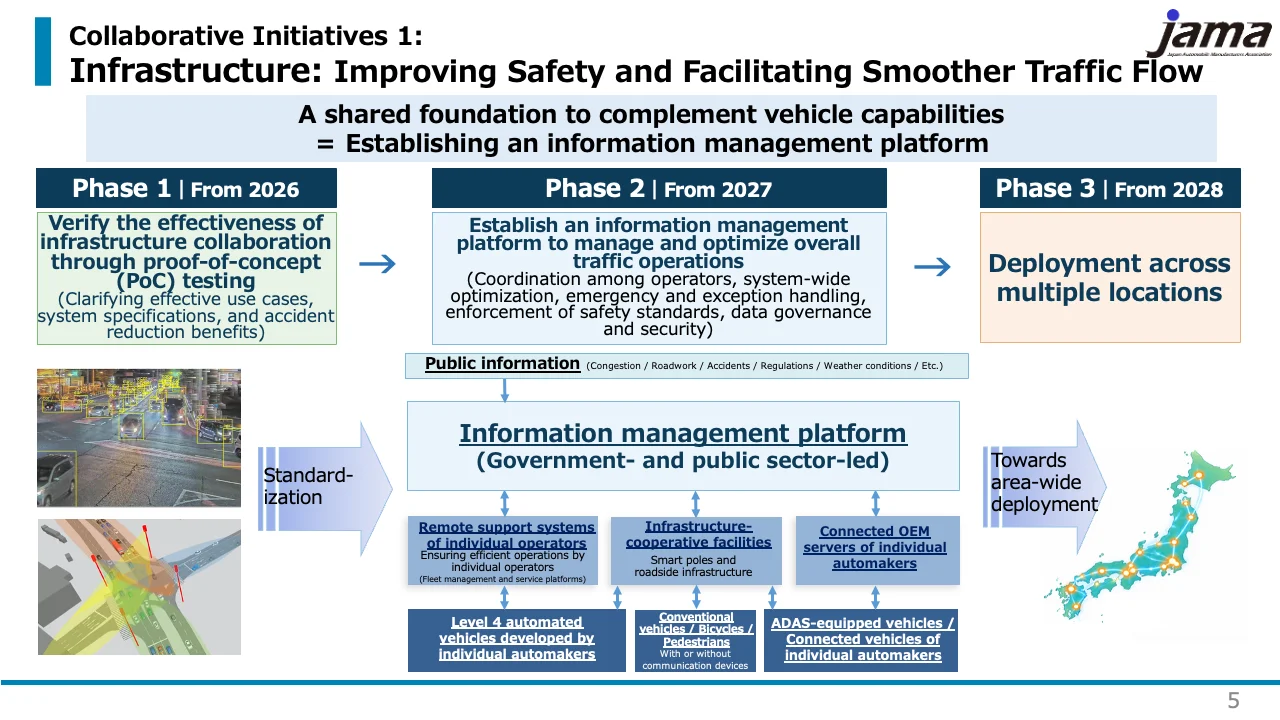
- The first common challenge is infrastructure coordination to improve safety and facilitate smoother traffic flow. In addition to vehicle autonomy, JAMA will promote coordination among vehicles equipped with automated driving systems, road infrastructure, communication networks, and public information availability through the establishment of an information management platform. JAMA intends to begin with initiatives that offer the greatest benefits, continuously improve them, and expand their application over time. Through these efforts, JAMA aims to contribute to the creation of a “Japanese-style” safe and secure mobility-based society while supporting the further development and wider adoption of automated driving technologies.
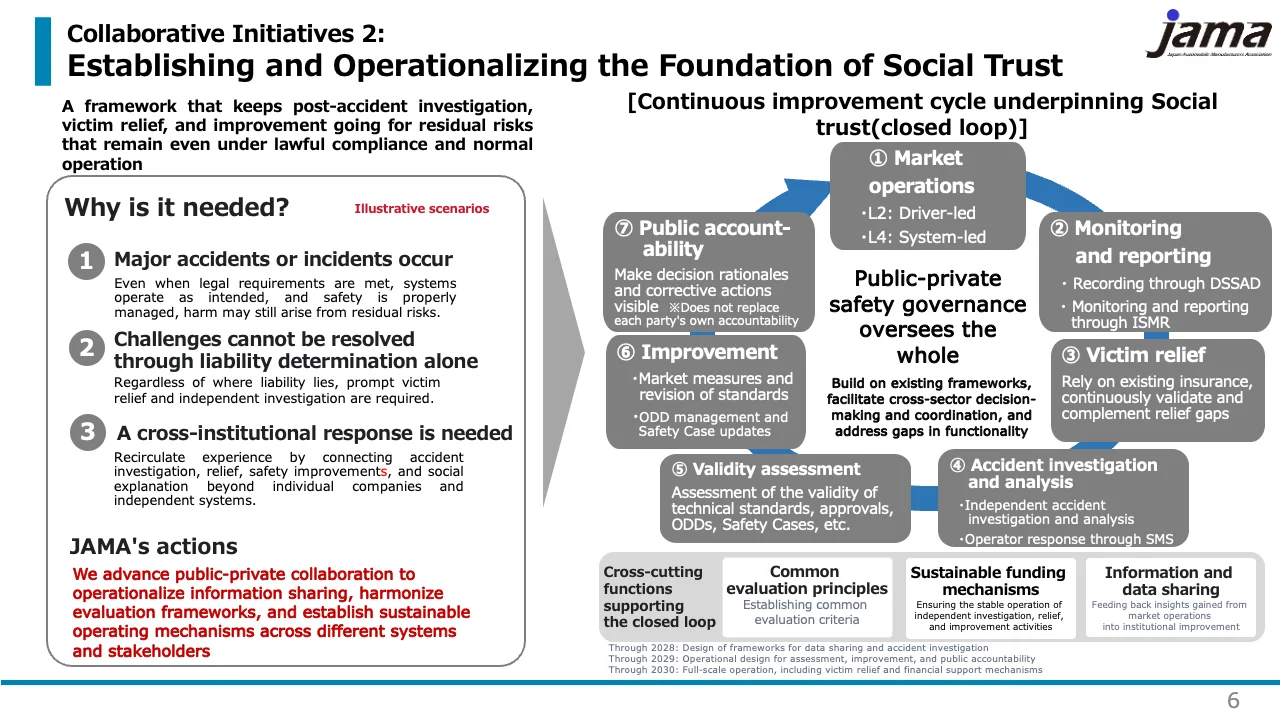
- The second common challenge is establishing a social trust foundation. JAMA proposes a framework under which operational facts obtained from market deployment can be independently verified and utilized for victim relief, accident investigations, validity assessments, safety improvements, and public accountability under public-private governance.
- Rather than ending the safety process at the certification stage, JAMA seeks a framework that continuously learns from accidents and incidents occurring after market introduction and uses those lessons to improve systems and technologies. The social trust foundation is intended to provide a mechanism through which society as a whole can continue learning and continuously improve road safety.
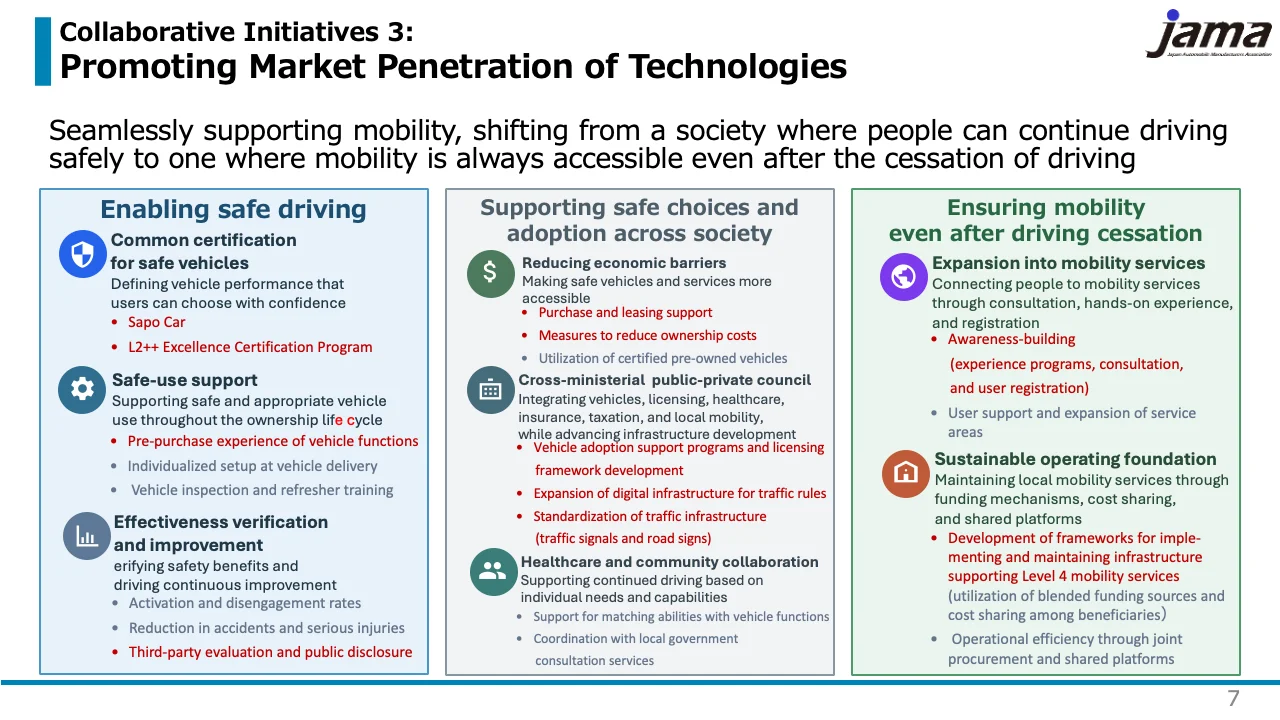
- The third collaborative area is market adoption of technologies. JAMA aims to define vehicle performance that users can choose with confidence while helping to establish an environment that supports proper use. Independent verification and disclosure of benefits, together with measures such as vehicle purchasing incentives and coordination with taxation and insurance systems, can help encourage wider adoption. JAMA also seeks to preserve mobility availability for people who no longer drive by promoting mobility services and developing common foundations and financial mechanisms to support local transportation networks. As these issues involve multiple administrative jurisdictions, JAMA is calling for the establishment of a cross-ministerial public-private forum and intends to participate actively in such discussions.
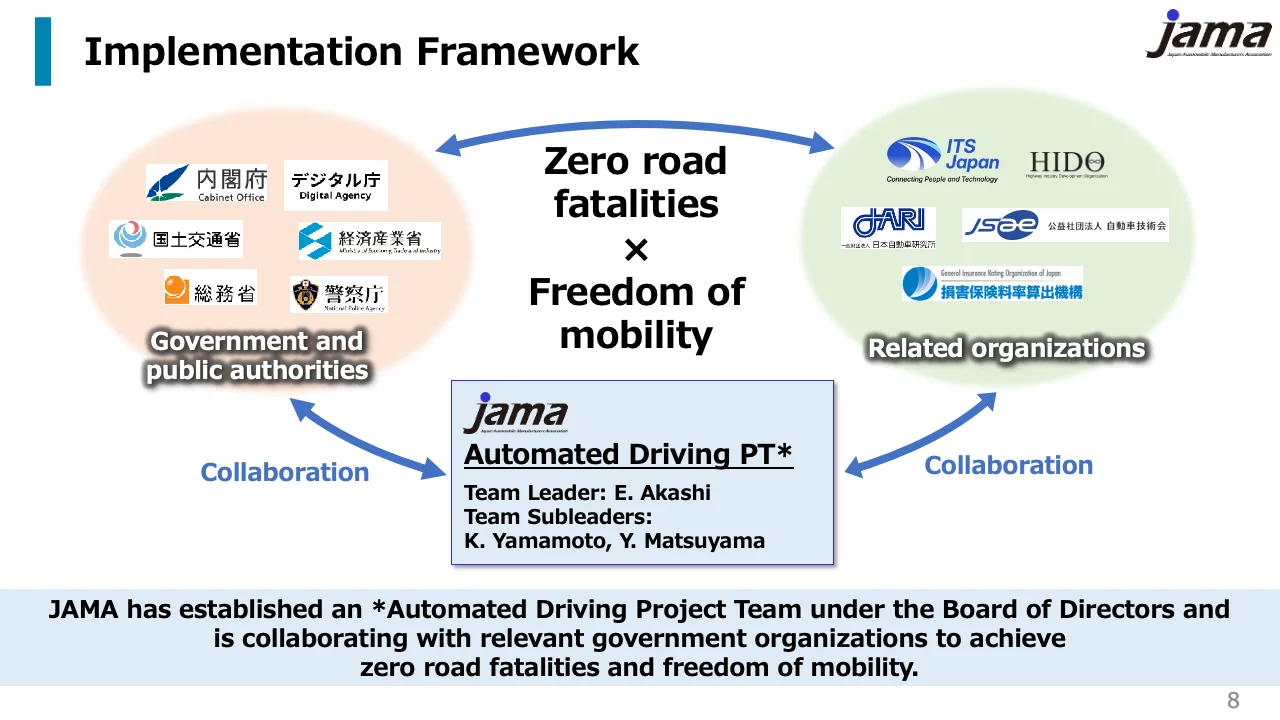
- As part of its implementation framework, JAMA is establishing an Automated Driving Project Team directly under its Board of Directors. Working together with relevant government agencies, industry stakeholders, and related organizations, JAMA will actively pursue the achievement of zero road fatalities as well as freedom of mobility.
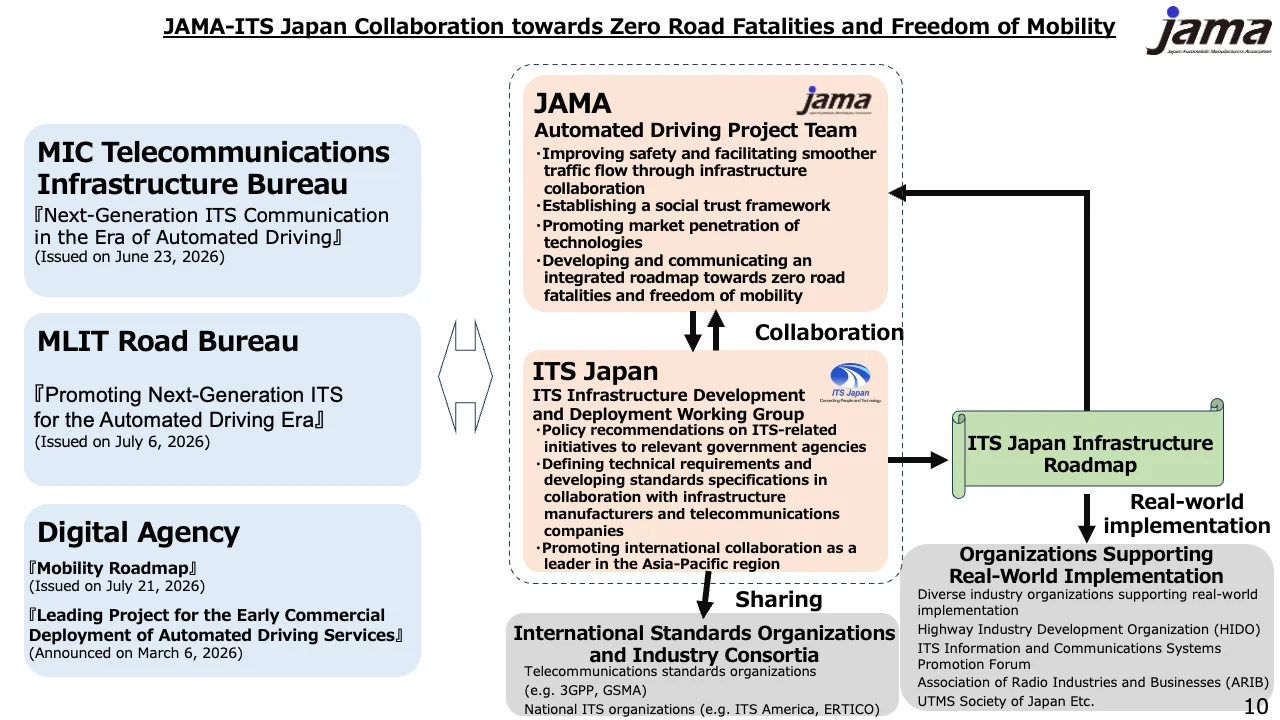
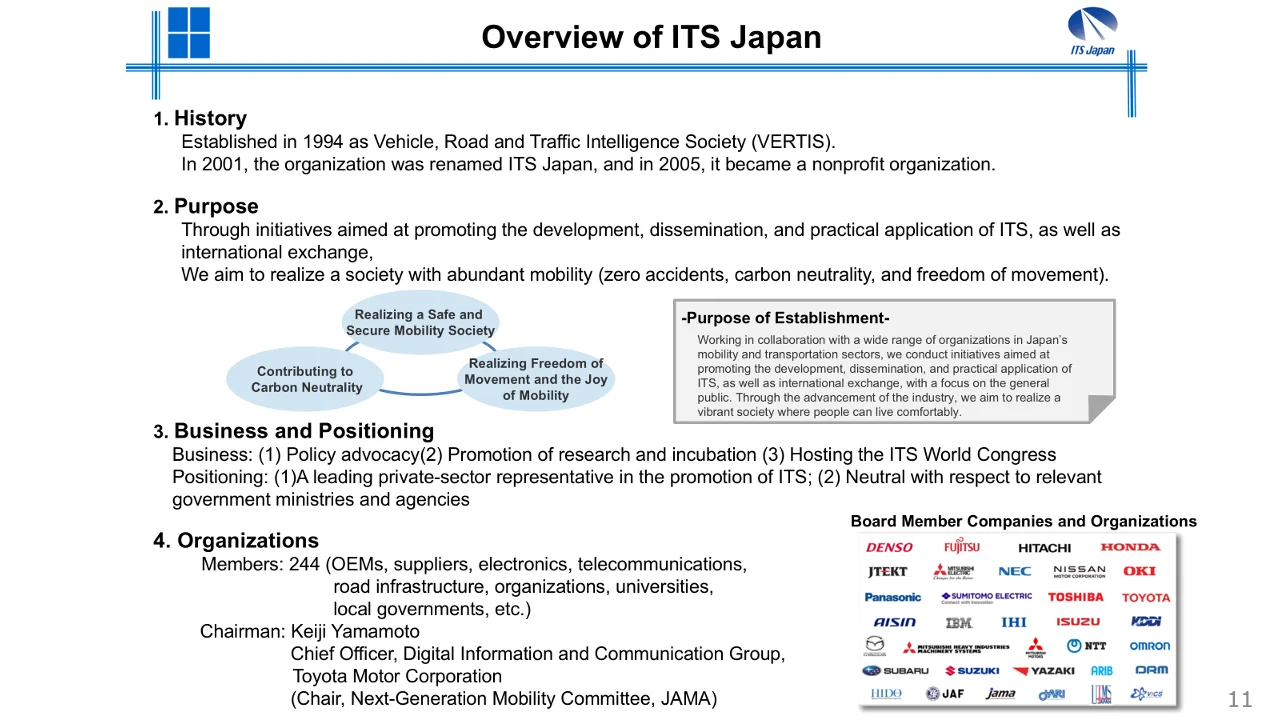
- Cooperation with ITS Japan* will be strengthened beyond information exchange and expanded into concrete initiatives. ITS Japan will also establish a dedicated team to work in step with JAMA. Based on JAMA’s roadmap for zero road fatalities and freedom of mobility, JAMA and ITS Japan will combine their expertise to develop an ITS infrastructure roadmap.
*ITS = Intelligent Transport Systems
- Through social implementation of information and communications infrastructure, policy proposals, and standardization activities, JAMA intends to contribute to international discussions on standards. Automated driving represents not only an evolution in vehicle technology, but also the creation of a social system capable of achieving zero road fatalities and freedom of mobility. Realizing this vision will require public-private collaboration in the areas of infrastructure coordination, social trust foundations, and market adoption, and JAMA will continue working closely with all stakeholders to advance these initiatives.
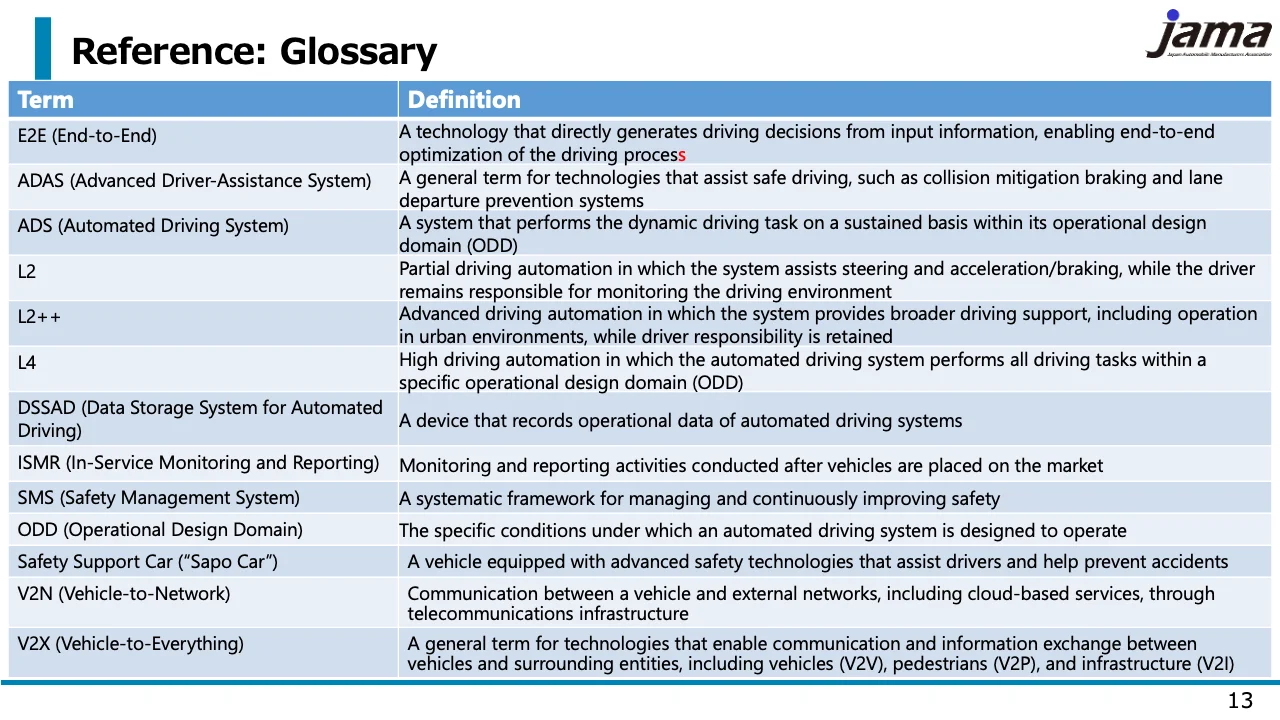
At the start of the second session, Chairman Koji Sato delivered remarks on initiatives to address the New Seven Priority Challenges.
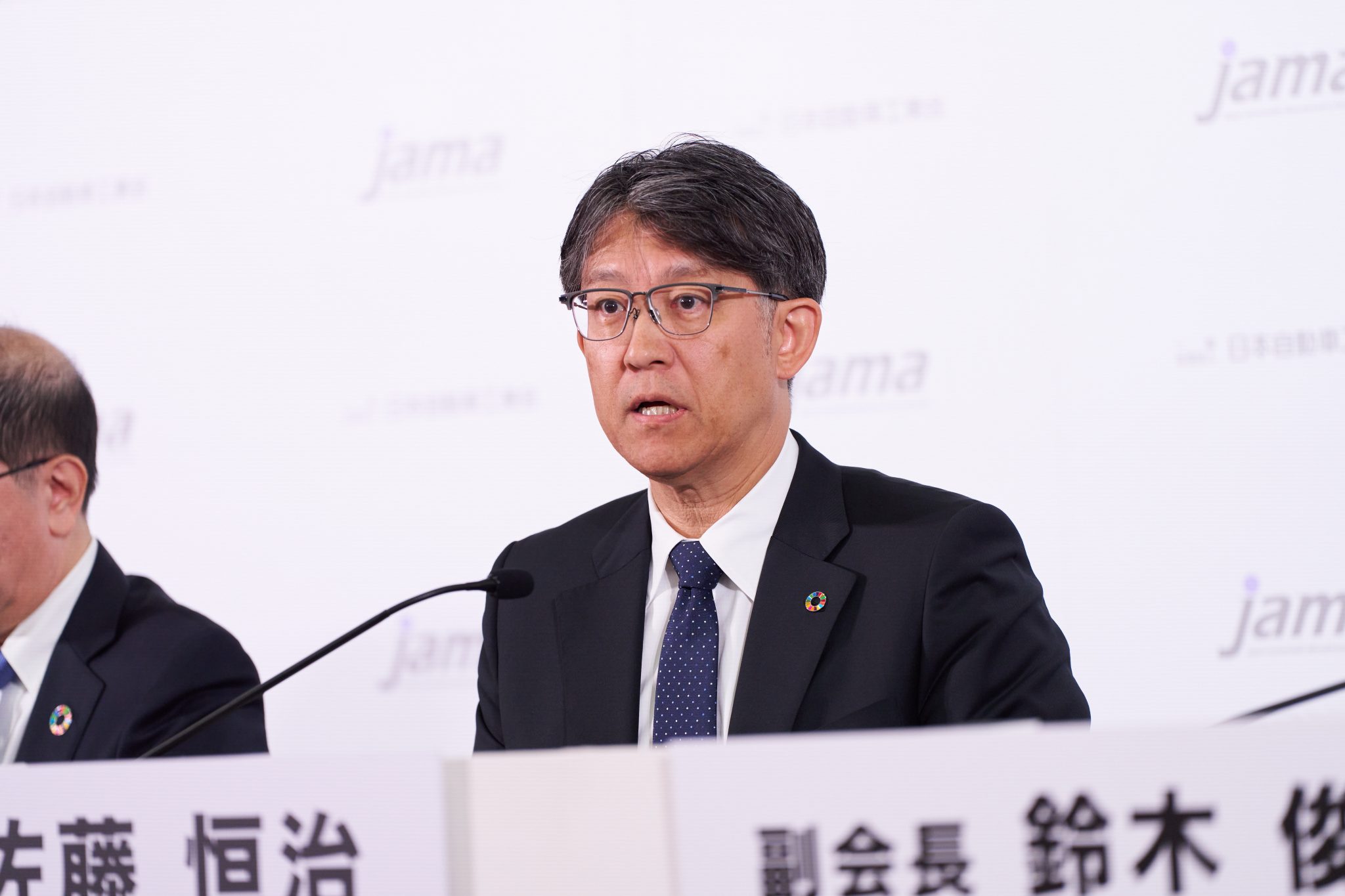
Koji SATO, Chairman (Vice Chairman, Chief Industry Officer, Toyota Motor)
First, I would like to say a few words in tribute to Hiroshi Okuda, who passed away last month. He served as Chairman of JAMA for two years beginning in 2000 and demonstrated exceptional leadership, achieving remarkable results in areas such as standardization and the integration of industry organizations. On behalf of the automotive industry, I would like to express my deepest condolences and offer my sincere prayers for his peaceful repose.
Today, I would like to discuss four topics.
The first is automated driving. Since around 2018, during the tenure of then-JAMA Chairman Akio Toyoda, we have continued discussions on the future direction of automated driving in Japan. Focused on the two key objectives of “Zero road fatalities” and “Freedom of mobility,” we have established a roadmap aimed at creating a harmonious mobility-based society through coordination with infrastructure. What I would particularly like to emphasize is the need to increase the pace of our efforts in this regard. As we promote real-world implementation, we must continue to enhance the capabilities of autonomous driving technologies. This is an area where each company can leverage its own technological strengths while, at the same time, accelerating progress across the industry as a whole.
Looking further ahead, we must consider how to build a social system that can ensure both safety and freedom of mobility through automated driving. The roadmap we have developed incorporates initiatives that include collaboration with infrastructure. Ultimately, this is an area that must be addressed from a broad perspective, taking into account developments in data ecosystems and semiconductors while remaining aligned with international trends. We intend to clearly demonstrate Japan’s position and build constructive relationships with stakeholders around the world.
The second topic is hydrogen. We are advancing what we call the Hydrogen Backbone Initiative. Its realization requires the simultaneous alignment of four key stakeholders: the national government, local governments, mobility providers, and infrastructure operators.
As hydrogen demand expands, it is important to reduce hydrogen costs and promote its adoption in other industries. We believe the automotive sector can serve as a first mover in creating demand and helping establish an economically viable hydrogen ecosystem in Japan.
The third topic is Japan Mobility Show Bizweek 2026. This year, the event will be held jointly with CEATEC as a business-to-business event over four days beginning on October 13. Under the theme “Your Move Moves the World,” the event will bring together approximately 200 companies, startups, universities, and other organizations from beyond the automotive sector. It will serve as a platform for exploring opportunities for collaboration while also addressing the New Seven Priority Challenges that JAMA has identified.
In particular, we are placing strong emphasis on strengthening connections with startups. Rather than simply providing a venue, we intend to present the challenges we are facing in more concrete terms and engage in two-way discussions with startups that can lead to meaningful collaboration. We hope many stakeholders will join us in making this event a success.
Finally, this year marks a half-century since the establishment of JAMA’s office in the United States. To commemorate this milestone, we will hold a 50th anniversary celebratory event in Washington, D.C., on September 30.
The relationship between the United States and Japan’s automotive industry is extremely important. For the past 50 years, Japanese automakers have built businesses deeply rooted in local communities across America. Today, they operate in 27 states and support approximately 2.4 million jobs, including sales-related employment. Moreover, one-third of all vehicles produced in the United States are manufactured by Japanese OEMs.
This anniversary event will not only be an expression of our gratitude for the past 50 years, it will also convey our commitment to continuing business activities that contribute to American industry and local communities over the next half-century and beyond.
