
JAMA's Side Event at COP30 (Belem, Brazil, November 10-22, 2025)
1. Seminar Abstract
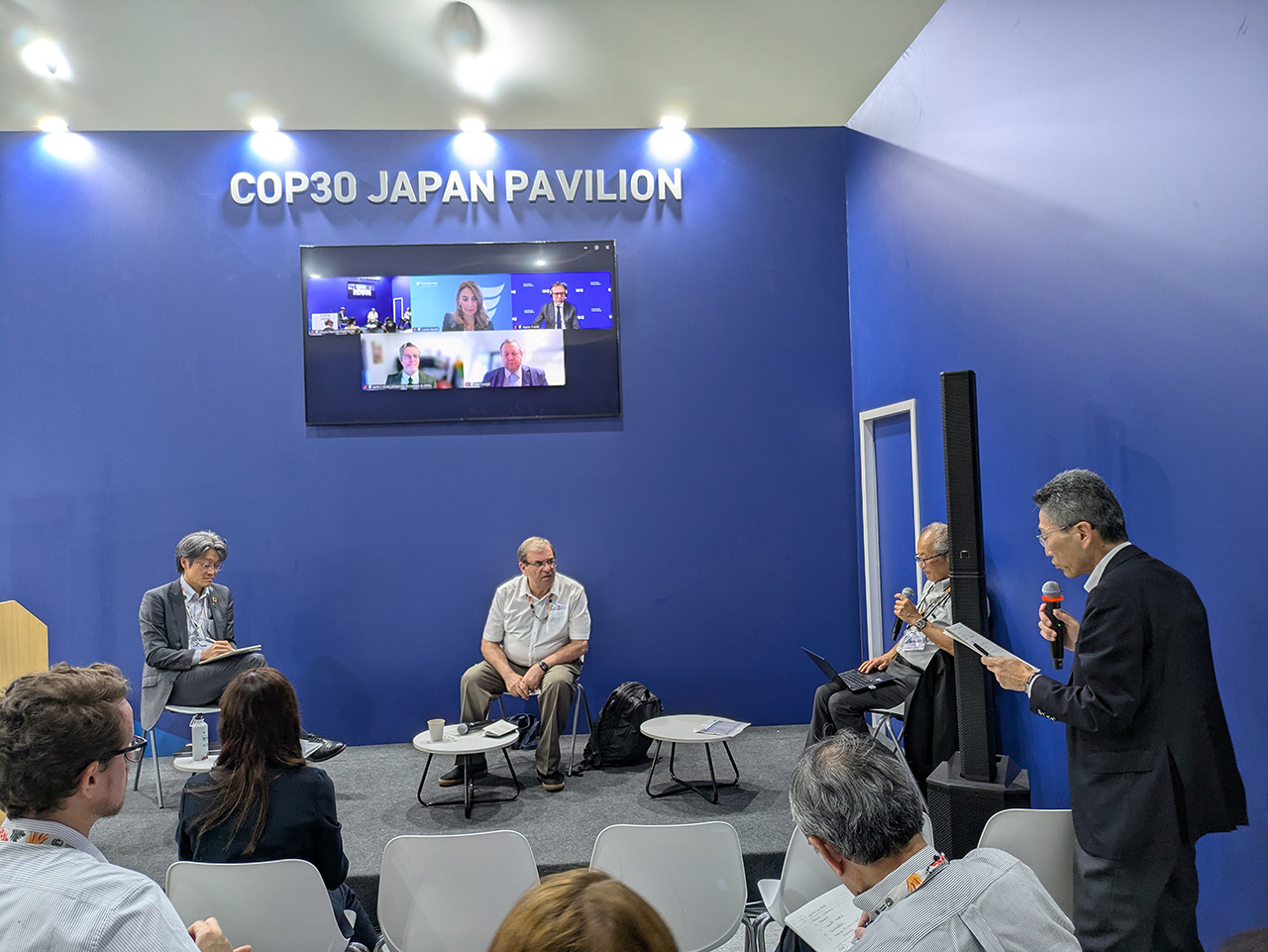
On November 19, 2025, a side event titled “Diversity in Carbon Neutrality -Accelerating Decarbonization with Sustainable Fuels-” was held at the Japan Pavilion during COP30 (officially, the 2025 United Nations Conference of the Parties of the UN Framework Convention on Climate Change) hosted by the Japan Automobile Manufacturers Association (JAMA).
In the opening remarks, government officials and related experts from Japan, Brazil, and Italy highlighted the growing momentum for sustainable fuels. Key topics included the Ministerial Meeting on Sustainable Fuels held in Osaka in September 2025, the "Belém 4x Pledge on Sustainable Fuels“ leaded by Brazil, and the expanding adoption of renewable fuels across Europe.
The event featured a panel discussion on decarbonization in the road transport sector which was moderated by Professor Jun Arima from the University of Tokyo and whose participants included scientists from Europe and the U.S., representatives from the automotive industry in Europe and Brazil as well as fuel industry in Europe.
【Panel Participants】
- Jun Arima*
Project Professor, Graduate School of Public Policy, University of Tokyo Leading author of IPCC AR6 WG3 Chapter 1, “Introduction and Framing”
*Moderator - Arisa Yonezawa*
Deputy Director, Automotive Industrial Strategy Office, Manufacturing Industries Bureau Ministry of Economy, Trade and Industry, Japan
*Opening remarks - Helena Gressler*
Head of the Energy and Mining Division, Ministry of foreign affairs, Brazil
*Opening remarks - David Chiaramonti*
Full professor, Polytechnic University of Turin, Italy; Chair, Clean Energy Ministerial (CEM) Biofuture Platform Initiative
*Opening remarks - Paolo Frankl
Head of the Renewable Energy Division, International Energy Agency (IEA) - Keith L Kline
Distinguished Scientist, Environmental Science Division, U.S. Oak Ridge National Laboratory (ORNL) - Henry Joseph Junior
Advisor to the President, Brazilian Association of Automotive Vehicle Manufacturers (ANFAVEA) - Petr Dolejsi
Mobility & Sustainable Transport Director, European Automobile Manufacturers' Association (ACEA) - Liana Gouta
Director General, FuelsEurope - Takao Aiba
Chair, International Climate Change Policy Expert Group, Japan Automobile Manufacturers Association (JAMA)
2. Summary of Opening Remarks:
Ms. Yonezawa, Ministry of Economy, Trade and Industry (METI), Japan explained that Japan is promoting a "multi-pathway approach" to simultaneously achieve decarbonization, economic growth, and energy security. She noted that relying on a single solution poses high risks and emphasized the need for flexible approaches tailored to the specific circumstances of each country. Furthermore, she introduced the growing international momentum for sustainable fuels -citing the Ministerial Meeting on Sustainable Fuels in September and the "Belém 4x Pledge on Sustainable Fuels“- and emphasized the importance of international collaboration involving both the public and private sectors.
Ms. Gressler, Ministry of Foreign Affairs, Brazil outlined the strengthening partnership between Brazil and Japan through initiatives such as the ISFM and the signing of the Belém 4x Pledge on Sustainable Fuels. She noted that international efforts to expand sustainable fuel use are gaining traction, with approximately 25 countries having signed the pledge to date(Nov 19th). She further explained that electrification and sustainable fuels are complementary and both are indispensable for achieving net-zero targets. Finally, she stated that clear government commitments, aligned with the actions of non-state actors, can generate the necessary momentum to reach the goal of quadrupling sustainable fuel production by 2035.
Prof. Chiaramonti, Polytechnic University of Turin, Italy / Chair of the Biofuture Platform* pointed out that road transport accounts for 70–80% of CO2 emissions within the EU transport sector, underscoring the critical need for emission reductions in this area. From this perspective, he explained the importance of proposals from the European Parliament and the Council to explicitly include the role of renewable fuels in EU CO2 regulations. He concluded by emphasizing a commitment to dialogue, stating that the Biofuture Platform actively welcomes input and proposals from various countries and stakeholders and stands ready to convey them to member governments.
*Biofuture Platform: An initiative launched at the 11th Clean Energy Ministerial (CEM-11) to accelerate the development, scaling, and deployment of sustainable bio-based alternatives to fossil-based fuels, chemicals, and materials. Currently, 23 countries are members, with Japan participating as an observer. International organizations such as the IEA and IRENA also support this initiative.
3. Summary of Speaker Presentations:

- According to the Institute of Energy Economics, Japan (IEEJ), one of the world‘s leading energy think tanks, it is possible to reduce CO2 emissions from the global road transport sector to levels aligned with the IPCC 1.5℃ scenario by 2050. Their analysis indicates that this goal is achievable not only through a rapid transition to electric vehicles (EVs) but also through a scenario combining the widespread adoption of hybrid (HEVs) and plug-in hybrid vehicles (PHEVs) with carbon-neutral fuels.
- While roughly 30 countires endorsed a declaration committing to 100% Zero‑Emission Vehicles (ZEVs) , significant disparities in national GDP levels and electricity prices render the transition to ZEVs considerably more attainable for signatory countries than for non‑signatories. This highlights the necessity of a "multi-pathway approach" tailored to regional realities.
- Most IPCC scenarios project over 160 EJ of bioenergy potential far exceeding the needs of aviation and shipping. Utilizing sustainable fuels in road transport will help scale up the overall global supply.

- In October, the IEA published a report that serves as the foundation for the “ Belém 4x Pledge on Sustainable Fuels ” The report highlights drivers and benefits of sustainable fuels, such as energy security, sustainability, and economic growth. It projects that global supply and demand could quadruple by 2035 if existing policies are appropriately implemented.
- While current debates often pit electrification against sustainable fuels, they are in fact complementary. Despite the push for electrification, sustainable fuels will continue to play a vital role in all transport sectors, with bioethanol use in road transport expected to increase significantly through 2030.
- Achieving a fourfold increase in a decade is ambitious but feasible through full implementation of existing policies and announced targets. The IEA proposes the following six key priority policy areas:
- Tailor roadmaps and policies to regional/national contexts
- Increase demand predictability to attract investment
- Cooperate on carbon accounting for enhanced comparability and progress in emission reductions
- Support innovation to reduce costs and accelerate scale-up
- Develop supply chains and infrastructure for long-term needs
- Make financing accessible to unlock potential in EMDEs

- Empirical evidence and 45 years of research show that biomass and land availability are not limiting factors. Vast amounts of biomass are incinerated for disposal or lost in wildfires with detrimental effects on people and the planet. Improved resource management will help meet targets to quadruple sustainable fuel supplies. Practical experiences from biofuel programs in Brazil, India, and the U.S. provide lessons and illustrate the value of integrated and efficient supply chains.
- Model simulations of Indirect Land Use Change (ILUC) are counterproductive distractions. Causal drivers of destructive practices must be understood and addressed by focusing on responsibility for deforestation in the real world. Establishing accountability for direct LUC is an effective alternative to perpetuating irresolvable ILUC debates.
- Food security is important and must be addressed by understanding contextual causes. Simply increasing production will not help given that over one third of food is wasted. Investing in more sustainable and diversified production via value-added bioenergy supply chains has been shown to strengthen rural food security.
- Clear and verifiable performance indicators with incentivize for continuous improvement help achieve development goals.

- According to Life Cycle Assessment (LCA) research on Brazil's transport decarbonization, hybrid vehicles using 100% ethanol achieve life-cycle emissions nearly equal to those of electric vehicles (EVs). This highlights the significant potential of biofuels for CO2 reduction.
- Rather than switching entirely to EVs, Brazil is reducing emissions by leveraging its existing foundation of clean electricity and biofuel supply.
- In September 2024, ANFAVEA and JAMA issued a joint statement on sustainable fuels. This initiative has since gained global support, with automobile associations from six other countries—Germany, Italy, South Korea, Switzerland, Belgium, and Romania—joining, bringing the total to eight signatory associations.

- The EU has set extremely ambitious targets, including a 100% CO2 reduction for cars and vans by 2035 and a 90% reduction for heavy-duty vehicles by 2040. However, the European automotive industry is now at a critical turning point where it risks losing its global competitiveness.
- Market forecasts suggest that BEV sales in 2035 will fall significantly short of regulatory targets. The current framework is not optimal for ensuring decarbonization while maintaining vehicle affordability and industrial competitiveness.
- While electrification will remain the core of decarbonisation, industry needs move towards a technology-neutral approach that leaves room for all technologies, including the role of sustainable and renewable fuels. These fuels are essential for decarbonizing the existing vehicle fleet already on the road as well.

- In the EU, technology neutrality is being overlooked in favor of specific technologies, effectively excluding sustainable fuels from the road transport sector. To achieve net-zero, we must pursue all decarbonization technologies in parallel rather than a single pathway. Sustainable fuels (such as biofuels and e-fuels) play a strategic role in complementing electrification.
- Sustainable fuels will not be produced exclusively for aviation and shipping, this is technically and economically not feasible; multiple studies show that supply can also cover the road transport sector. It is urgent that EU legislation reintroduces the concept of technology neutrality and recognizes the role of sustainable fuels in all transport modes.
- To unlock investments of up to 400 billion euros by 2050, we need ambitious and consistent policies, regulatory certainty, and predictable demand. For these reasons, we fully support the six policy priorities proposed by the IEA.
4. Concluding Remarks by Professor Arima:

- We have had a highly meaningful discussion today regarding the current status, outlook, and challenges surrounding sustainable fuels. In our dialogue on energy transition, two keywords stand out: "pragmatism" and, above all, "diverse pathways.“
- As noted by Petr, sustainability is a complex challenge. While Battery Electric Vehicles (BEVs) will undoubtedly be a crucial part of decarbonizing the transport sector, we have reaffirmed that sustainable fuels also play an essential role.
- Given that circumstances vary by country and region, it is vital to utilize all available technological options.
- The partnership between Japan and Brazil was highlighted at the Ministerial Meeting on Sustainable Fuels in September and continues here at COP30. Under the Brazilian Presidency's leadership, an ambitious goal to quadruple sustainable fuel production by 2035 has been set. We are seeing real progress, with a growing number of countries and industrial groups declaring their support for these ambitious targets.
- I look forward to our gathering again at COP31 next year—ideally hosted once more by JAMA—to review the progress we have achieved over the coming year.
5. Event Summary
Through the presentations and discussions today, we have deepened our understanding of the vital role sustainable fuels play in decarbonizing the road transport sector. This event served as a platform to communicate the importance of the "multi-pathway approach"—a strategy promoted by Japan—to a global audience.
Consequently, we will continue to advance a multiplicity of efforts, including electrification and the proactive introduction of vehicles compatible with these fuels. Together with automobile associations around the world, we will continue our efforts to achieve our common goal of decarbonizing road transport.

(From top left)
Frankl, Gouta,
Kline, Dolejsi,
Aiba、Chiaramonti、Gressler、Yonezawa、Joseph、Arima
Seminar Highlights
Event Archive
▼you can find the reports of JAMA's side event at COP27 (Nov. 2022) here
▼you can find the reports of JAMA's side event at COP28 (Dec. 2023) here
▼you can find the reports of JAMA's side event at COP29 (Dec. 2024) here
